Active Cross-Section Meridian:
Refraction Simulator & Physiological Optics
Educational simulator — not a medical device.
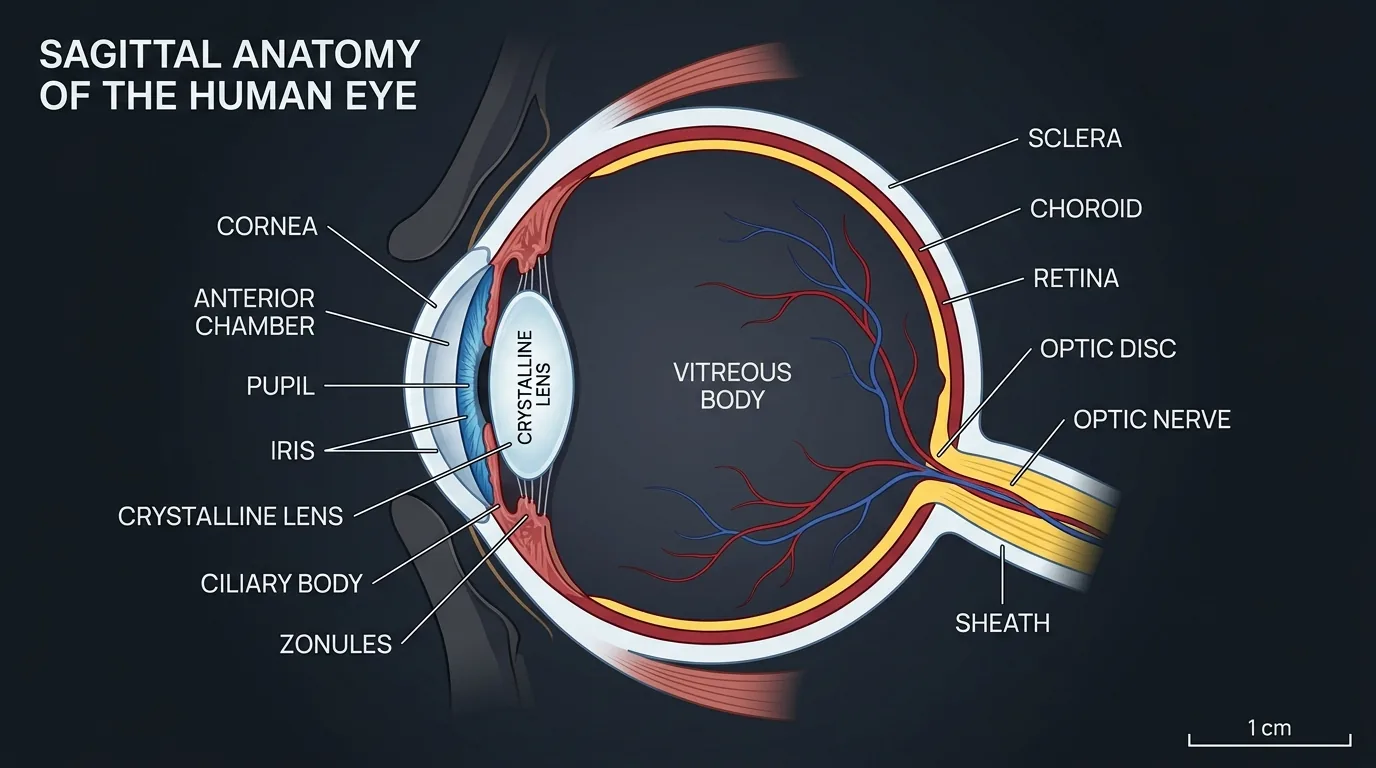
In an emmetropic eye, parallel light rays from infinity are refracted by the cornea (~43 D) and crystalline lens (~17-20 D) so that they converge exactly onto the fovea centralis of the retina (axial length ~24.0 mm) without requiring any accommodative effort.
Light rays converge to a focal point in front of the retina. This occurs either because the eyeball is too long (axial myopia) or the optical elements refract too strongly (refractive/curvature myopia). Diverging past the focal point, rays hit the retina as a blurred blur circle. Corrected by a concave (divergent / minus) lens that moves the focal point back onto the retina.
Light rays converge toward a virtual point behind the retina because the eye is either too short (axial hyperopia) or too weak (refractive hyperopia). A convex (convergent / plus) lens adds positive vergence to bring the focal point forward onto the retina.
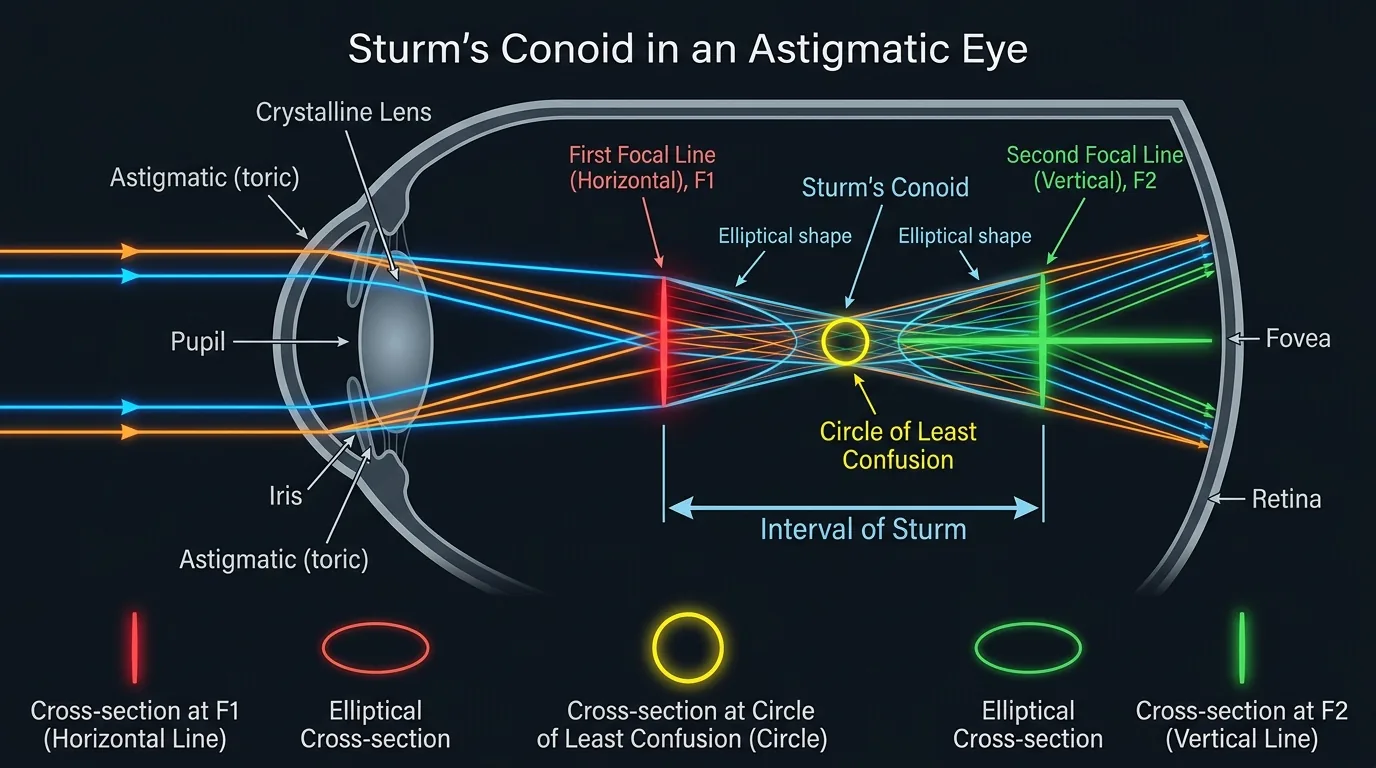
The cornea or lens possesses different refractive powers along two perpendicular meridians, creating an aspheric interval of Sturm between two distinct focal lines. Spherocylindrical lenses (combining spherical and cylindrical curves at a specific axis) neutralize both meridians simultaneously.
A full sphero-cylindrical trial lens is written S / C x A: a spherical power (plus or minus) that treats the eye's mean refractive error, plus a cylindrical power confined to a single axis that treats astigmatism, plus the axis (1-180 deg) at which that cylinder is ground. Both principal meridians must be neutralized independently — a sphere-only lens can correct one meridian while leaving the other with Sturm's conoid uncorrected.
A spectacle lens acts at the plane where it sits, not at the eye. Moving a lens of power F a distance d changes the power it effectively delivers at the cornea to F' = F / (1 - d.F) [Bennett & Rabbetts, Clinical Visual Optics]. This is why a high-power spectacle prescription must be converted before fitting as a contact lens (d -> 0), and why a spectacle sliding down the nose changes a strong myope's or hyperope's effective correction.
Real ophthalmic lenses are not flat slabs: a "best form" lens series selects its front surface ("base") curve from the lens power by Vogel's Rule to minimize oblique astigmatism across the field of view. That same front curve and the lens's center thickness also set its Spectacle Magnification (Power Factor x Shape Factor) — plus lenses magnify the retinal image, minus lenses minify it, which is why anisometropic patients can experience aniseikonia.