Progressive (PAL) & multifocal lenses: corridor length, Minkwitz theorem, fitting height, prism thinning & slab-off
Quick answer
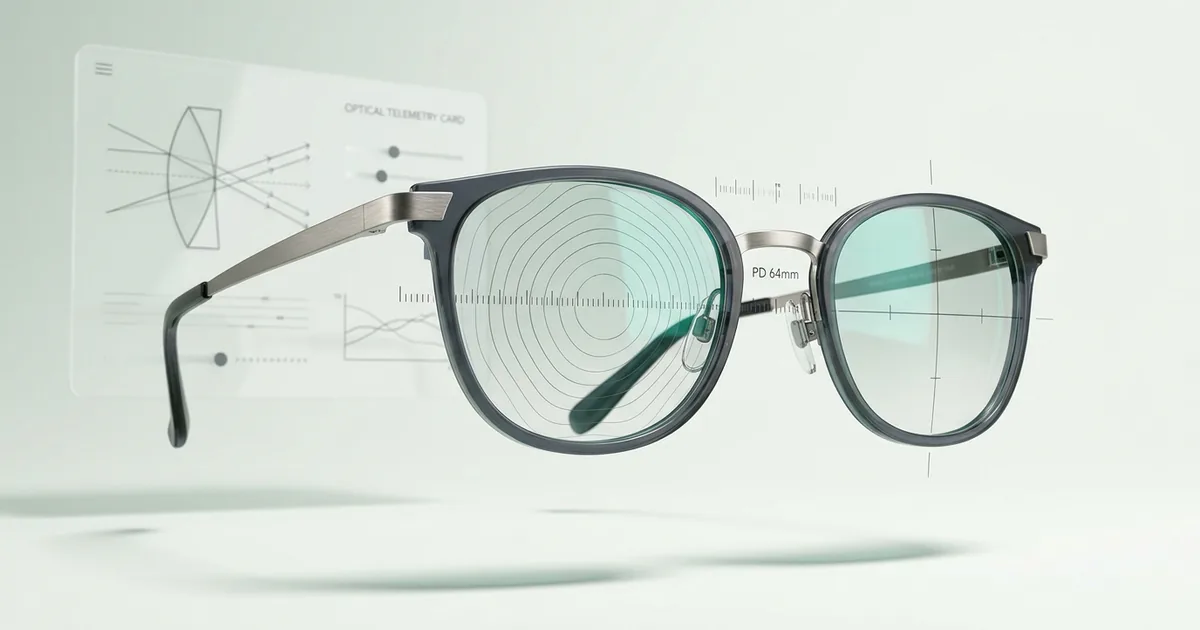
Multifocal lenses restore clear distance, intermediate and near vision in presbyopia. Bifocals and trifocals use visible segments with sharp power transitions (and potential image jump), whereas progressive addition lenses (PALs) increase power smoothly down a narrow corridor. By Minkwitz’s theorem, unwanted peripheral astigmatism rises in proportion to the add power divided by corridor length — making accurate fitting height, near inset, prism thinning and slab-off essential for adaptation.
Open the simulatorComparing single vision, bifocal, trifocal, progressive & office designs
| Lens design | Vision zones | Key optical trade-off | Primary verification mark |
|---|---|---|---|
| Single vision | One focal distance | Widest clear field; no near add | Optical centre (OC) |
| Bifocal | Distance + Near | Visible line; image jump at segment top | Segment height (lower lid / limbus) |
| Trifocal | Distance + Intermediate + Near | Adds intermediate band (≈ 50% add); two lines | Top of intermediate segment |
| Progressive (PAL) | Seamless distance → intermediate → near | No lines, but peripheral unwanted astigmatism | Fitting cross at pupil centre |
| Office / Occupational | Wide intermediate + Near | Generous desk/screen corridor; not for driving | Fitting cross & degression add |
Minkwitz theorem, corridor length & iso-cylinder maps
A continuous progressive surface cannot change spherical power without introducing unwanted cylinder beside the progression corridor. Minkwitz’s theorem states that peripheral astigmatism builds laterally at roughly twice the rate at which the add power rises along the corridor.
- Shorter corridor: reaches full reading add in less vertical eye drop (fits shallower frames), but creates steeper peripheral astigmatism and a narrower clear corridor.
- Longer corridor: spreads the power rise over more millimetres, widening the intermediate corridor and softening peripheral swim, but requires a taller frame.
- Freeform back-surface vs moulded front-surface: placing the progressive optics on the back surface brings the corridor closer to the eye’s centre of rotation, widening the effective angular field of view.
- Reading iso-cylinder maps: contour lines drawn every 0.50 D outline the clear distance, corridor and near zones (commonly bounded by the 0.50 D iso-cylinder line) alongside the permanent laser engravings and removable lab ink markings.
Fitting height, image jump, prism thinning & slab-off
- Fitting height minimum: if the fitting cross sits too close to the lower rim, edging cuts off the near reference point (NRP) and the patient cannot reach full reading power.
- Image jump (bifocals): equals
Add × distance from segment top to segment optical centre (cm), base down. Flat-top (D-seg) segments place their OC near the top line to minimise jump. - Prism thinning (progressives): grinding equal base-down prism (typically
≈ 0.6 × Add) on both lenses balances upper and lower edge thickness, making high-add progressives thinner and lighter without inducing vertical imbalance. - Slab-off (bicentric grind): in anisometropia, looking down 8–10 mm to read generates unequal vertical prism between OD and OS. When near vertical imbalance exceeds about 1.5 Δ, base-up slab-off on the more minus (or less plus) lens restores single binocular reading vision.
Practice it on the virtual patient
- Open Spectacle Lab → Lens mode, select Progressive, set an Add of +2.25 D and inspect the 3D colour map and 2D iso-cylinder contours.
- Shorten the corridor length and watch the 0.50 D clear corridor width narrow and peak peripheral astigmatism rise (Minkwitz behaviour).
- Toggle Prism thinning and switch between Back (freeform) and Front (moulded) surfaces, then enter anisometropia (e.g. OD −1.00, OS −4.00) to see the near vertical imbalance and slab-off recommendation.
Frequently asked questions
Why do short-corridor progressive lenses feel narrower?
By Minkwitz’s theorem, compressing the same reading add into a shorter vertical corridor increases the rate of power change, which doubles the lateral gradient of unwanted astigmatism and narrows the clear intermediate and near zones.
What is prism thinning on a progressive lens?
Prism thinning is equal base-down prism (around 0.6 × add) ground across both progressive lenses to equalize top and bottom thickness, reducing weight and edge bulk without causing vertical prism imbalance between the eyes.
What happens if a progressive lens fitting height is below the design minimum?
The bottom of the near reading zone gets edged off to fit the shallow frame, forcing the wearer to tilt their chin up sharply or leaving them unable to reach full reading power.
Related guides
- Spectacle dispensing & lens materials: refractive index, Abbe number, Prentice’s rule & ANSI Z80.1 Compare 7 lens materials, master Prentice’s rule, vertex distance, pantoscopic tilt and ANSI Z80.1 troubleshooting.
- Refractive errors and astigmatism: myopia, hyperopia and Sturm's conoid Understand myopia, hyperopia and astigmatism, read a prescription and correct for vertex distance.
- Streak retinoscopy: with motion, against motion and neutralization Read with and against motion, neutralize both meridians and correct for working distance.
Simulators for this guide
References & further learning
Sources for the teaching principles. Listing a source does not imply its institution endorses or validates this simulator.