Spectacle dispensing & lens materials: refractive index, Abbe number, Prentice’s rule & ANSI Z80.1
Quick answer
Accurate spectacle dispensing translates a refraction prescription into a comfortable, optically faithful pair of glasses. Selecting a lens balances refractive index (which reduces thickness and weight) against Abbe number (which controls colour fringing). Fitting the frame accurately — matching monocular PD, fitting height, vertex distance and lowering the optical centre 0.5 mm per degree of pantoscopic tilt — prevents unwanted Prentice prism, induced cylinder and ANSI Z80.1 failures.
Open the simulatorComparing the 7 core ophthalmic lens materials
Two numbers define how a lens material behaves optically: the refractive index (n) determines how strongly light bends (higher index yields thinner lenses for high powers), while the Abbe number (V) measures resistance to chromatic dispersion (higher Abbe means cleaner off-centre colour clarity).
| Material | Index (n) | Abbe (V) | Density (g/cm³) | Clinical trade-off |
|---|---|---|---|---|
| CR-39 | 1.498 | 58 | 1.32 | Benchmark optical clarity; thicker in high powers |
| Crown glass | 1.523 | 59 | 2.54 | Highest clarity & scratch resistance, but heavy |
| Trivex | 1.532 | 45 | 1.11 | Lightest impact-resistant lens; ideal for drill-mount rimless |
| Polycarbonate | 1.586 | 30 | 1.20 | Thin & impact-resistant, but lowest Abbe (TCA risk in high Rx) |
| High-index 1.60 | 1.600 | 42 | 1.30 | Strong balance of thinness, tensile strength and clarity |
| High-index 1.67 | 1.670 | 32 | 1.35 | Noticeably thinner for ±5.00 D to ±8.00 D; moderate TCA |
| High-index 1.74 | 1.740 | 33 | 1.47 | Thinnest plastic option for very high prescriptions |
As a practical rule, transverse chromatic aberration (TCA = P ÷ Abbe) becomes noticeable above about 0.1 Δ. A −9.00 D patient looking 10 mm off-centre through polycarbonate (Abbe 30) experiences 0.30 Δ of colour fringing — blue and orange halos on high-contrast text.
Core fitting measurements: PD, fitting height, vertex & pantoscopic tilt
- Monocular PD (Mono PD): measured separately from the facial midline to each pupil centre. Faces are rarely perfectly symmetric, so high prescriptions require monocular rather than binocular PD.
- Horizontal decentration:
Decentration = (Frame PD ÷ 2) − Mono PD. Positive values shift the optical centre nasally; large decentration increases minimum blank size (MBS = ED + 2 × decentration + 2 mm) and edge thickness. - Vertex distance: distance from the corneal apex to the back surface of the lens (typically 12–14 mm). Above ±4.00 D, changes in vertex distance alter effective power by
Fc = F ÷ (1 − d · F), withdin metres. - Pantoscopic tilt & the 0.5 mm rule: frames normally tilt inward at the bottom by 8°–12°. Lowering the optical centre 0.5 mm per degree of tilt keeps the lens optical axis aligned with the eye’s centre of rotation and prevents oblique astigmatism described by Martin’s tilt equations.
Prentice’s rule & ANSI Z80.1 verification tolerances
When the line of sight passes away from the optical centre, the lens acts as a prism: P = F × d, where P is prism in prism dioptres (Δ), F is lens power in the meridian of decentration, and d is displacement in centimetres.
| Error type | Clinical symptom | Key ANSI Z80.1 prism limit |
|---|---|---|
| Horizontal PD error | Eye strain, frontal headache, “pulling” sensation | ≤ 0.67 Δ net horizontal imbalance (or ≤ 2.5 mm) |
| Vertical OC height mismatch | Vertical diplopia (“stepped” TV or screen edges) | ≤ 0.33 Δ vertical prism imbalance |
| Low-Abbe material in high Rx | Blue/orange fringes on signs and text off-centre | Check TCA = P ÷ V (noticeable > 0.1 Δ) |
| Excess vertex in anisometropia | Unequal image sizes (aniseikonia), hesitation on stairs | 1% noticeable; ≥ 3% often symptomatic |
Systematic workflow for troubleshooting unhappy spectacle wearers
- Verify the finished lenses first: measure sphere, cylinder, axis and optical centre locations on a manual lensometer.
- Compare against the ordered prescription and mono PDs: calculate induced horizontal and vertical prism with Prentice’s rule.
- Check the frame on the face: measure actual fitted vertex distance and pantoscopic tilt; verify whether the OC was lowered for tilt.
- Audit material and magnification: in high prescriptions or anisometropia, evaluate Abbe number (TCA) and spectacle magnification difference (aniseikonia).
Practice it on the virtual patient
- Open Spectacle Lab in Lens mode, enter −8.00 DS and compare centre thickness, edge thickness, pair weight and Abbe number across all 7 materials.
- Switch to Fit mode on the 3D patient, increase pantoscopic tilt to 12° and toggle Lower the OC for tilt while watching Martin’s induced cylinder in Optics.
- Open Cases and solve all 7 patient complaints — inspecting each lab-made pair before comparing the corrected pair in 3D.
Frequently asked questions
Which is better for high myopia: polycarbonate or 1.67 / 1.74 high-index?
For high myopia above −6.00 D, 1.67 or 1.74 high-index is noticeably thinner than polycarbonate, and 1.60 or CR-39 provides cleaner colour clarity if the patient is sensitive to chromatic aberration. Polycarbonate has the lowest Abbe number (30), making blue/orange edge fringes more likely in strong prescriptions.
How much vertical prism imbalance is allowed under ANSI Z80.1?
Under ANSI Z80.1, unwanted vertical prism imbalance between the right and left lenses should not exceed 0.33 Δ (or 1.0 mm vertical OC difference for low powers). Because human vertical fusional reserves are small, even 0.50–1.00 Δ of vertical imbalance can cause asthenopia or diplopia.
When should I adjust a prescription for vertex distance?
Vertex distance compensation becomes clinically meaningful at powers of ±4.00 D and above whenever the fitted frame sits at a different distance from the cornea than the trial frame or phoropter used during refraction.
Related guides
- Progressive (PAL) & multifocal lenses: corridor length, Minkwitz theorem, fitting height, prism thinning & slab-off Master progressive (PAL) corridor width, Minkwitz astigmatism, fitting height, image jump, prism thinning and slab-off.
- Refractive errors and astigmatism: myopia, hyperopia and Sturm's conoid Understand myopia, hyperopia and astigmatism, read a prescription and correct for vertex distance.
- Streak retinoscopy: with motion, against motion and neutralization Read with and against motion, neutralize both meridians and correct for working distance.
Simulators for this guide
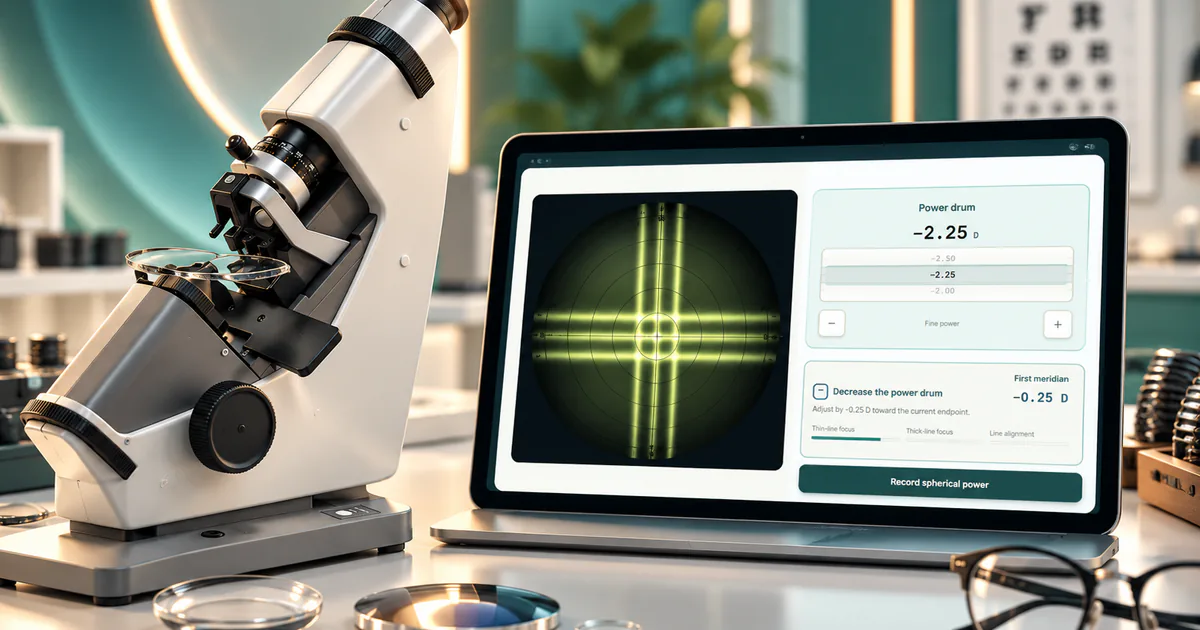
- Lensometer SimulatorRead a finished spectacle lens on a manual lensometer: close the doubled American Cross mires on the power drum, find the axis on the unbroken thin line, take the cylinder as the difference of two readings, and watch Prentice's Rule put prism on the reticle rings.Explore the simulator
- 3D Spectacle Lab (Ophthalmic Dispensing)Learn spectacle dispensing on a 3D frame and 3D patient: 14 frame parts, PD/vertex/tilt fitting, 7 lens materials with thickness maps, progressive & bifocal contour maps, Prentice prism, ANSI Z80.1 checks and 7 troubleshooting cases.Explore the simulator
References & further learning
Sources for the teaching principles. Listing a source does not imply its institution endorses or validates this simulator.