3D Spectacle Lab: master ophthalmic dispensing, lens optics & progressive lenses
Go from holding a frame to troubleshooting unhappy spectacle wearers in one free 3D lab: inspect every frame part, fit a 3D patient, compare lens thickness across 7 materials, map progressive lens astigmatism, verify ANSI Z80.1 tolerances and solve real dispensing errors.
Open 3D Spectacle Lab Lens Materials & Optics Guide Progressive & Multifocal Guide
Quick answer
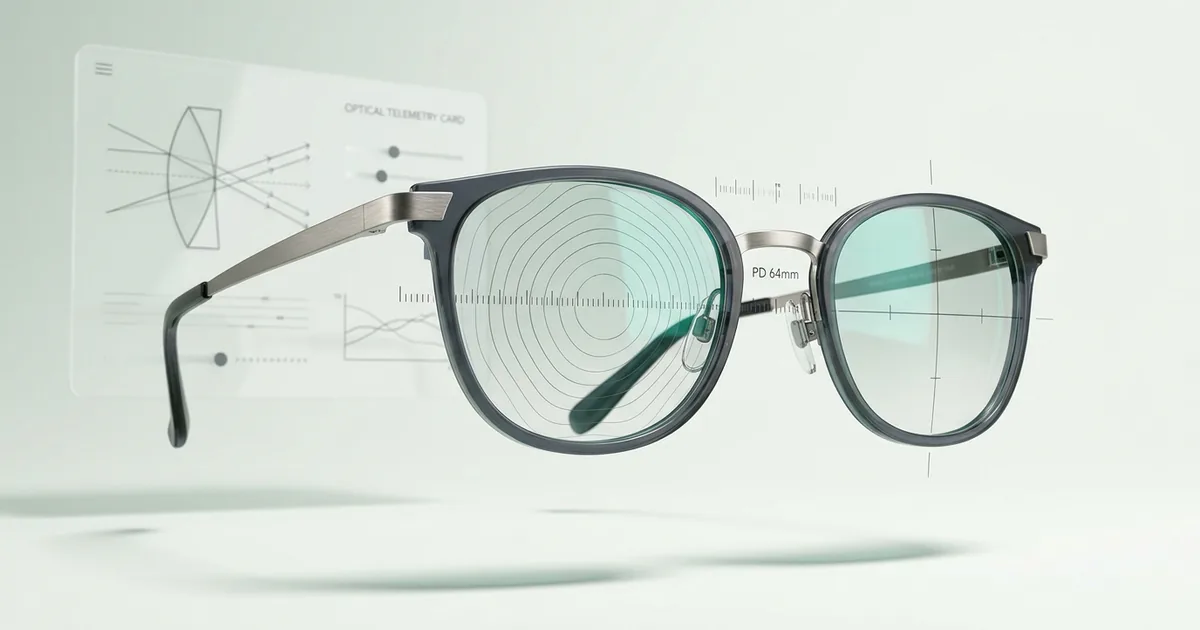
Pupilla’s Spectacle Lab is a free browser-based 3D ophthalmic dispensing simulator in English and Arabic. Across five interactive modes — Explore, Fit, Lens, Optics and Cases — learners disassemble 14 frame parts across 5 frame styles, measure mono/binocular PD, fitting height, vertex distance and pantoscopic tilt on a 3D patient, compare 7 lens materials (CR-39, Crown glass, Trivex, Polycarbonate, 1.60, 1.67 and 1.74), design single-vision, bifocal, trifocal, progressive (PAL) and office lenses with live iso-cylinder and iso-add maps, calculate as-worn power, Prentice prism, chromatic aberration (TCA), aniseikonia and ANSI Z80.1 pass/fail tolerances, and diagnose 7 complaint-driven clinical dispensing cases.
Spectacle Lab at a glance
| Feature | Detail |
|---|---|
| Interactive modes | 5 — Explore (3D anatomy), Fit (3D patient), Lens & Multifocal, Optics & ANSI Z80.1, Clinical Cases |
| Frame styles & parts | 5 frame types (full-metal, browline, acetate, semi-rimless, rimless) · 14 selectable parts · 7-step exploded assembly |
| Prescription range | OD & OS independently, ±20.00 D in 0.25 D steps, cylinder and axis 1°–180° |
| Lens materials | 7 — CR-39 (1.498), Crown glass (1.523), Trivex (1.532), Polycarbonate (1.586), High-index 1.60, 1.67 and 1.74 |
| Multifocal & PAL studio | Single vision, Bifocal, Trifocal, Progressive (freeform back or moulded front) and Office designs + 2D/3D iso-cylinder & iso-add contour maps |
| As-worn optics engine | Vertex compensation, Martin’s tilt formula, Prentice’s rule, horizontal/vertical prism imbalance, TCA (Abbe), spectacle magnification, aniseikonia & ANSI Z80.1 check |
| Troubleshooting cases | 7 graded patient-complaint cases with side-by-side “Made pair” vs “Corrected pair” inspection |
| Export & sharing | HD multi-angle Frame Studio Card export (4-angle grid, editorial, 3-view spec, hero) |
| Language & access | English and Arabic · Free in any modern browser · No account or installation required |
Five interactive workflows inside Spectacle Lab
- 1 · Explore (3D Frame Anatomy & Assembly) — Rotate and zoom five real frame architectures (full-metal, browline, acetate, semi-rimless nylon cord, and rimless drill-mount). Open or fold the temples, click any of 14 parts to inspect its dispensing function, or step through a 7-stage exploded disassembly.
- 2 · Fit (3D Patient Measurements) — Seat the frame on a 3D patient head and adjust nose-pad height, vertex distance, pantoscopic tilt, temple spread and mono/binocular PD. Watch live readouts for fitting height, wrap angle, horizontal decentration (in/out) and the 0.5 mm/degree OC drop rule.
- 3 · Lens & Multifocal Designer — Enter any OD/OS prescription, switch between 7 lens materials, inspect live 3D thickness colour maps, Vogel’s base curve, centre/edge thickness, minimum blank size (MBS) and pair weight. Switch to bifocal, trifocal, progressive (PAL) or office designs to inspect corridor width (Minkwitz), iso-cylinder contours, prism thinning, slab-off and permanent laser engravings.
- 4 · Optics & ANSI Z80.1 Verification — See what the wearer actually experiences: vertex-compensated power at the cornea, tilt-induced cylinder (Martin’s formula), Prentice prism at the pupil, binocular horizontal/vertical imbalance, transverse chromatic aberration (TCA), spectacle magnification, aniseikonia and instant ANSI Z80.1 pass/fail checks.
- 5 · Cases (Clinical Troubleshooting) — Seven patients return unhappy with new glasses — afternoon headaches, stepped vertical TV diplopia, blue/orange fringes, stairs looking uneven, aphakic distance blur, or tilt-induced blur. Inspect the lab-made pair across Fit, Lens and Optics, identify every fault, select the optical fix and compare before vs after in 3D.
7 ophthalmic lens materials compared side by side
Choose high-index for thinness or high-Abbe for crisp colour clarity: Spectacle Lab computes centre thickness, edge thickness, pair weight and chromatic aberration (TCA) from these exact material constants.
| Material | Refractive index (n) | Abbe number (V) | Density (g/cm³) | Min centre thickness |
|---|---|---|---|---|
| CR-39 | 1.498 | 58 | 1.32 | 2.0 mm |
| Crown glass | 1.523 | 59 | 2.54 | 2.2 mm |
| Trivex | 1.532 | 45 | 1.11 | 1.0 mm |
| Polycarbonate | 1.586 | 30 | 1.20 | 1.0 mm |
| 1.60 | 1.600 | 42 | 1.30 | 1.2 mm |
| 1.67 | 1.670 | 32 | 1.35 | 1.2 mm |
| 1.74 | 1.740 | 33 | 1.47 | 1.2 mm |
Multifocal & progressive (PAL) lens design lab
- Five optical designs — Compare Single Vision, Bifocal, Trifocal, Progressive (PAL) and Office/Occupational lenses on the same prescription and frame.
- Freeform vs moulded surfaces — Switch progressive optics between back-surface freeform and front-surface moulded designs and inspect how corridor width and peripheral astigmatism shift.
- 2D & 3D contour maps — Overlay iso-cylinder (unwanted astigmatism in 0.50 D bands) and iso-add power maps directly on the 3D lens and in a 2D lab blueprint with distance/near circles, fitting cross and permanent engravings.
- Clinical dispensing safeguards — Automatic warnings when fitting height falls below the design minimum, live image-jump calculation for bifocals, equal base-down prism thinning (≈ 0.6 × add) and bicentric slab-off recommendations when near vertical imbalance exceeds 1.5 Δ.
7 complaint-driven spectacle troubleshooting cases
Real optometry dispensing exams test whether you can turn a vague patient complaint into an exact optical measurement. Every case below is interactive and graded from the underlying optics engine.
| Patient case | Presenting complaint & optical clue |
|---|---|
| Headache by mid-afternoon | High myope, new glasses, eyes feel pulled. |
| The TV image steps | Hyperope, strain within an hour, vertical doubling. |
| Coloured edges off-centre | High myope, sharp centrally, colour fringes when looking away. |
| One eye sees it bigger | Anisometrope, unequal image sizes, unsure on stairs. |
| Pushes her glasses closer | High plus, distance blur that clears when the frame is pushed in. |
| Not as crisp as the trial frame | Myope, strong tilt, a blur he cannot clear. |
| Headaches and a vertical double | Myope, semi-rimless, two centration errors. |
Complete optics & dispensing training path on Pupilla
- 1 · Measure the prescription — Practise objective and subjective refraction in the Retinoscopy Simulator and Refraction Simulator.
- 2 · Master ophthalmic optics — Connect power crosses, transposition and prism in the Ophthalmic Optics Lab.
- 3 · Verify finished lenses — Read sphere, cylinder, axis and prism on a manual focimeter in the Lensometer Simulator.
- 4 · Dispense & troubleshoot in 3D — Fit frames, choose lens materials, map progressives and solve patient complaints in Spectacle Lab.
- 5 · Deep-dive guides — Read the Spectacle Dispensing & Lens Materials Guide and the Progressive & Multifocal Lens Guide.
What is modelled — and what is not
- Thickness, base curve (Vogel’s rule), weight and MBS use typical ophthalmic lab teaching minimums; individual optical labs and proprietary aspheric or freeform blanks vary.
- Progressive (PAL) contour maps are parametric educational models that demonstrate Minkwitz behaviour, corridor width and unwanted peripheral astigmatism — not proprietary manufacturer ray-traced designs.
- Spectacle Lab is an educational and exam-preparation tool, not a clinical ordering system or medical device. Real dispensing requires calibrated frame measurements, physical verification on a lensometer and supervised clinical judgement.
Frequently asked questions about Spectacle Lab & dispensing
What is Pupilla Spectacle Lab?
Pupilla Spectacle Lab is a free browser-based 3D ophthalmic dispensing simulator for optometry students, opticians and ophthalmology trainees. It lets you disassemble 3D frames, measure fit on a 3D patient, compare 7 lens materials, design progressive and bifocal lenses with iso-cylinder maps, check ANSI Z80.1 tolerances and troubleshoot 7 patient complaints.
How do refractive index and Abbe number affect eyeglass lenses?
A higher refractive index (such as 1.67 or 1.74) bends light more strongly, making high-power lenses thinner and flatter. The Abbe number measures chromatic dispersion: lower Abbe materials like polycarbonate (Abbe 30) create noticeable colour fringing (transverse chromatic aberration) in high prescriptions, whereas CR-39 (Abbe 58) and Trivex (Abbe 45) offer cleaner peripheral colour clarity. Compare all 7 materials live in Spectacle Lab.
How does Prentice’s rule cause headaches or double vision in new glasses?
Prentice’s rule (P = F × d, with decentration d in centimetres) shows that looking away from a lens’s optical centre induces unwanted prism. If the lab places optical centres at the wrong PD or unequal heights in a high prescription, horizontal prism causes eye strain and headaches, while vertical prism imbalance exceeding the ANSI Z80.1 limit of 0.33 Δ can cause vertical diplopia.
Why does vertex distance matter for high prescriptions?
Because a lens’s effective power changes as it moves closer to or farther from the cornea (Fc = F ÷ (1 − d·F)). Above roughly ±4.00 D, even a 5 mm shift in vertex distance noticeably alters clarity — for example, a +12.00 D aphakic lens sitting too far forward feels over-plussed until the wearer pushes the frame closer.
Why should the optical centre be lowered for pantoscopic tilt?
As a clinical rule of thumb, the optical centre is lowered by 0.5 mm for every degree of pantoscopic tilt so the lens’s optical axis passes through the eye’s centre of rotation. Failing to drop the OC on a steeply tilted frame induces unwanted cylinder and sphere shifts described by Martin’s tilt equations.
How do progressive (PAL) corridor length and Minkwitz theorem work?
In a progressive addition lens, power smoothly increases from distance to near along a narrow corridor. By Minkwitz’s theorem, the faster the add power rises over a shorter corridor, the steeper the unwanted peripheral astigmatism beside the corridor — narrowing the clear reading and intermediate zones. Explore this interactively on the 2D and 3D iso-cylinder maps in Spectacle Lab.
When is slab-off (bicentric grinding) needed in multifocal glasses?
When a patient has significant anisometropia and looks down through the reading zone of bifocal or progressive lenses, Prentice’s rule creates unequal vertical prism between the two eyes. Once near vertical imbalance exceeds roughly 1.5 Δ, bicentric slab-off (base-up prism ground on the more minus or less plus lens) neutralizes the vertical doubling.
Is Spectacle Lab free and available in Arabic?
Yes. Spectacle Lab is completely free in any modern browser on desktop, tablet or phone, with no account required, and supports full English and Arabic clinical terminology.
References & further learning
Sources for the teaching principles. Listing a source does not imply its institution endorses or validates this simulator.
For education and training only. Pupilla is not a medical device and must not be used for diagnosis or treatment decisions.